
How to Write an Aquaculture Business Plan Investors Take Seriously
Quick answer
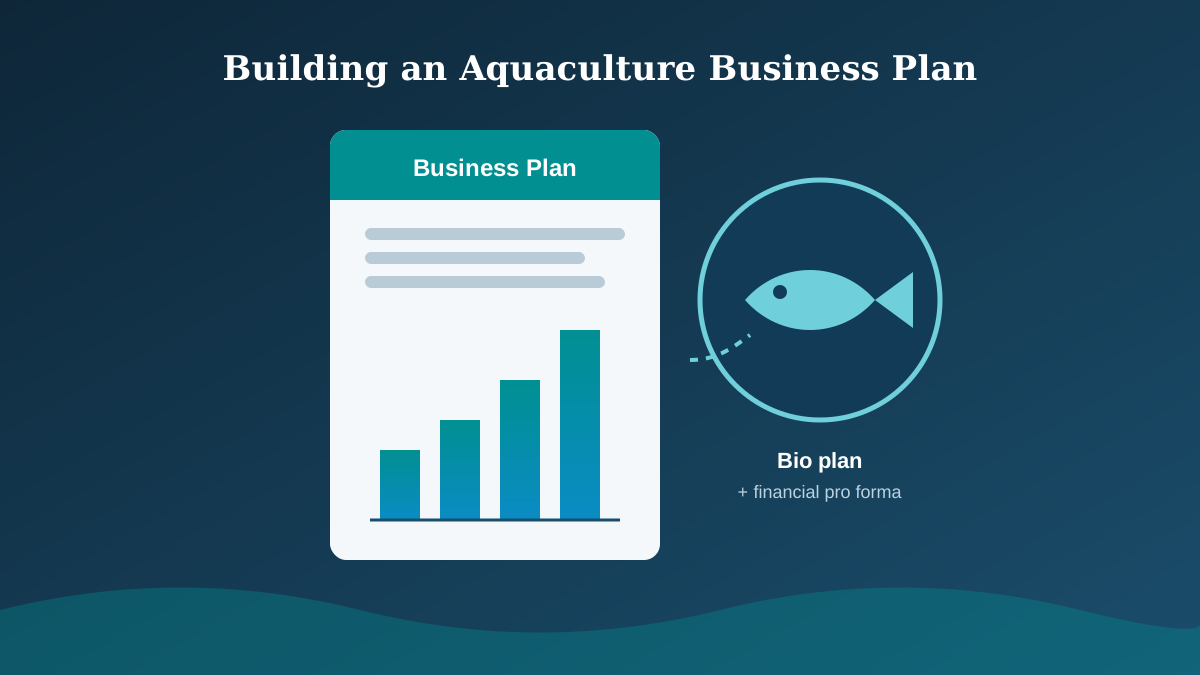
A credible aquaculture business plan covers the market and buyers, species and system choice, site, production (bio) plan, capital and operating costs, a financial pro forma, permitting path, team, and risks. What investors trust most is a plan where the production assumptions and the financial model match, so every revenue number can be traced back to realistic stocking, growth, survival, and harvest.
What do investors look for in an aquaculture business plan?
Investors in aquaculture have usually seen optimistic plans before. They look for evidence that the team understands the biology, the engineering, and the market, and that the numbers hold up when someone pushes on them. Clear writing helps, but technical credibility is what gets a plan funded.
Our founder wrote the business plan and raised the capital for Aquaco LLC, a commercial-scale land-based marine RAS facility in Florida, so we approach plans from the operator's side of the table (read the story).
What sections should an aquaculture business plan include?
- Executive summary. The opportunity, the ask, and why this team can deliver, in a few pages.
- Market and sales plan. Who will buy the product, in what form, at what price, and through which sales channels.
- Species and system. Why this species, and why this production system (see our RAS design guide).
- Site. Location, water, power, access, and zoning, ideally backed by a feasibility review.
- Production plan (bio plan). Stocking, growth, survival, feed, and harvest schedules. See our bio plan service.
- Capital budget. Construction, equipment, contingency, and start-up costs.
- Operating budget. Feed, energy, labor, juveniles or seed stock, maintenance, and overhead.
- Financial pro forma. Multi-year projections of cash flow, profitability, and funding needs. See our pro forma service.
- Permitting and regulatory path. Which approvals are needed and when (see our permitting guide).
- Team and advisors. Who will build and run the farm, and where outside expertise fills gaps.
- Risks and mitigation. Biological, technical, market, and regulatory risks, and what you'll do about each.
Why must the bio plan and the pro forma match?
Revenue in aquaculture comes from biology: how many animals you stock, how fast they grow, how many survive, and when they reach market size. If the financial model assumes more harvest, faster growth, or earlier sales than the production plan supports, experienced investors will find the gap, and the whole plan loses credibility.
Building the bio plan and the financial pro forma together, with the same assumptions, is the single most effective way to strengthen an aquaculture business plan.
Common aquaculture business plan mistakes
- Optimistic growth or survival assumptions with no support.
- Underestimating the time from construction to first harvest and first revenue.
- Too little working capital to cover feed, energy, and payroll before sales ramp up.
- No evidence that buyers exist at the assumed price.
- Ignoring permitting time in the schedule.
- No contingency for construction overruns or early operating problems.
Is a business plan only for raising money?
No. A good plan becomes the project's operating reference: it guides system design, construction budgeting, and hiring, and gives you a baseline to measure performance against once the farm is running.
Getting help with your plan
We can write a complete aquaculture business plan, review a draft before it goes to investors, or build just the pro forma or bio plan. It's one of the clearest examples of why early expert input pays off. Schedule a consultation to talk it through.
Frequently asked questions
What should an aquaculture business plan include?
An executive summary, market and sales plan, species and system choice, site, production (bio) plan, capital and operating budgets, financial pro forma, permitting path, team, and risks with mitigation.
What is a bio plan in aquaculture?
A bio plan is the biological production plan: stocking, growth, survival, feed, and harvest schedules for a species in a specific system. It drives the revenue and feed-cost assumptions in the financial model.
What is a financial pro forma for a fish farm?
A pro forma is a set of multi-year financial projections covering capital costs, operating costs, production, revenue, cash flow, and funding needs. It shows whether the project is viable under realistic assumptions.
Do I need a feasibility study before a business plan?
It's often wise. A feasibility review tests whether the site, species, system, and market can work before you invest in a full business plan.