RAS Design Explained: The Key Components of a Recirculating Aquaculture System
Quick answer
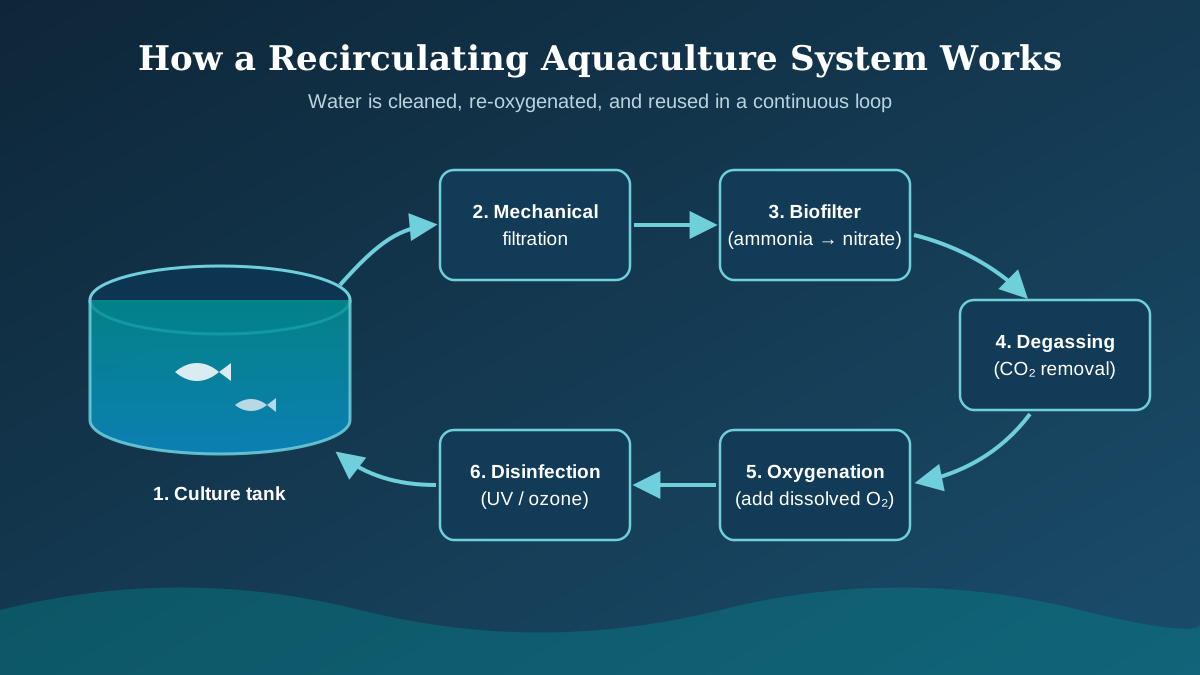
A recirculating aquaculture system (RAS) is a land-based fish farming system that cleans and reuses most of its water. Its core components are culture tanks, mechanical filtration, biofiltration, degassing (CO₂ removal), oxygenation, and disinfection, supported by pumps, temperature control, monitoring and alarms, and backup power. Good RAS design keeps water quality stable for your species at your planned production level, with enough redundancy that one failure doesn't put the fish at risk.
What is a recirculating aquaculture system?
In a RAS, water flows out of the fish tanks, through a series of treatment steps, and back into the tanks. Because most of the water is reused, a RAS can be built on land, away from the coast or a large water source, and gives the operator tight control over temperature, water quality, and biosecurity. That control is why RAS is used for everything from hatcheries to full-scale grow-out, including land-based marine farms like the commercial facility our founder built in Florida (read our story).
The trade-off is complexity. Every function that nature performs in a pond or the ocean has to be engineered, powered, and maintained.
The main components of a RAS
1. Culture tanks
Tanks hold the fish. Their shape, size, and water flow pattern affect how well waste is carried to the drain, how evenly oxygen is distributed, and how easy it is to grade, harvest, and clean. Tank design should follow the species and the bio plan, not the other way around.
2. Mechanical filtration (solids removal)
Uneaten feed and fish waste must be removed quickly, before they break down and foul the water. Systems commonly use settling zones, swirl separators, and drum or screen filters. Removing solids early reduces the load on every step that follows.
3. Biofiltration
Fish excrete ammonia, which is toxic. A biofilter is home to beneficial bacteria that convert ammonia to nitrite and then to much less harmful nitrate. Biofilters must be sized for the feed load at peak production and given time to mature before full stocking. An undersized or immature biofilter is one of the most common causes of RAS problems.
4. Degassing (CO₂ removal)
Fish and bacteria produce carbon dioxide, which builds up in recirculated water and can stress fish. Degassing towers or aeration strip CO₂ out of the water.
5. Oxygenation
Dense fish populations need more oxygen than aeration alone can supply, so many systems add pure oxygen through dedicated equipment. Oxygen is critical: it's one of the first things monitoring and alarm systems should watch.
6. Disinfection
Ultraviolet (UV) light and ozone are used to reduce pathogens and improve water clarity. Disinfection supports biosecurity but doesn't replace good husbandry and quarantine procedures.
7. Support systems
Pumps move the water; heating or cooling keeps temperature on target; sensors, controls, and alarms warn staff before a problem becomes a loss; and backup power and redundant equipment keep life support running during an outage. These are easy to under-budget and expensive to add later.
What is an engineered RAS system?
An engineered RAS is a recirculating aquaculture system designed as one integrated whole, with every component sized from the same production numbers, rather than assembled from parts chosen one at a time. The biofilter, solids removal, oxygen supply, pumps, and backup systems all trace back to the species, stocking density, and peak daily feed load in the bio plan.
The difference shows up when the farm is running at full production. A well-engineered system holds water quality steady on the heaviest feeding days, keeps fish safe when a pump or the power fails, and is practical for staff to operate. See how I approach this in my RAS design consulting work.
Which design decisions drive RAS operating costs?
Capital cost gets most of the attention, but operating cost decides whether a farm is profitable. The biggest drivers are usually:
- Energy for pumping, oxygen production or purchase, and temperature control.
- Labor, which depends on how easy the system is to feed, clean, maintain, and harvest.
- Feed, where good water quality supports better growth and feed conversion.
- Redundancy, which costs more up front but protects against catastrophic losses.
This is why independent equipment selection matters: the cheapest pump or filter is not always the cheapest to own.
Common RAS design mistakes
- Designing the system before the production plan is settled.
- Undersizing the biofilter or solids removal for peak feed load.
- Skipping backup power, alarms, or redundant pumps and oxygen supply.
- Leaving too little room for maintenance access, grading, and harvest.
- Rushing commissioning and stocking before the biofilter is established.
Most of these are cheap to fix on paper and expensive to fix in concrete, which is the core argument for getting expert input early.
How does RAS compare with other systems?
RAS isn't the right answer for every project. Sea cage operations use natural water bodies and have very different costs and permitting. Flow-through systems use more water but less treatment. Life support systems (LSS) in zoos and aquariums use many of the same technologies to maintain water quality for display animals rather than production. A feasibility review should compare options before you commit.
Getting help with RAS design
Aquaco Advisors LLC works with all system types, including RAS, LSS, sea cages, hatcheries, and grow-out facilities. We combine current technology with proven systems and husbandry practices. See my RAS design consulting service or schedule a consultation.
Frequently asked questions
What does RAS stand for in aquaculture?
RAS stands for recirculating aquaculture system: a land-based system that treats and reuses most of its water through filtration, biofiltration, degassing, oxygenation, and disinfection.
What are the main components of a RAS?
Culture tanks, mechanical filtration for solids, a biofilter to convert ammonia to nitrate, degassing to remove carbon dioxide, oxygenation, and disinfection such as UV or ozone, supported by pumps, temperature control, monitoring, alarms, and backup power.
Can RAS be used for marine fish?
Yes. Land-based marine RAS facilities raise saltwater species. Aquaco Advisors LLC's founder built and operated a commercial-scale land-based marine RAS facility in Florida.
What is an engineered RAS system?
An engineered RAS is a recirculating aquaculture system designed as one integrated whole, with the biofilter, solids removal, oxygenation, pumps, and backup systems all sized from the same production numbers and peak feed load.
What is the difference between RAS and LSS?
Both use similar water treatment technology. RAS usually refers to production systems for farming fish, while life support systems (LSS) maintain water quality for animals in zoos, aquariums, and similar facilities.