Why Early Expert Input Saves Aquaculture Projects Time and Money
Quick answer
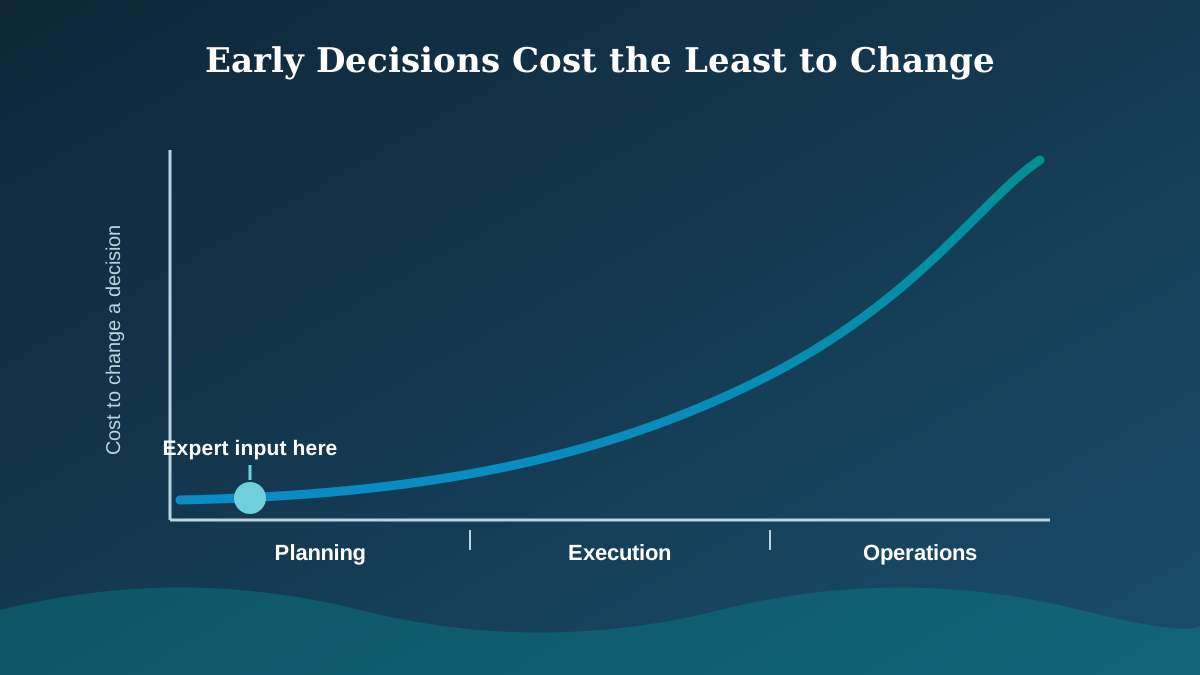
Early expert input saves aquaculture projects time and money because most long-term costs are locked in during planning: the site, the system, the scale, and the business plan's assumptions. Changes are cheap on paper and expensive in concrete. The highest-value places for early input are site selection, the business plan and bio plan, permitting, system design and equipment, and commissioning and SOPs.
Many aquaculture project owners wait to ask for help until something goes wrong. It's an understandable instinct. But the projects that tend to succeed over the long term usually do the opposite: they bring in experienced input at the start, when it costs the least and changes the most.
Asking for help isn't a sign of weakness
Nobody likes to feel they're admitting they don't have every answer, especially when investors, partners, or a government board are watching. But look at how serious organizations work. Developers hire engineers before pouring concrete. Investors commission due diligence before writing a check. Getting outside expertise early isn't a lack of confidence. It's how careful people protect a significant investment.
Aquaculture is no different. Whether you're planning a land-based fish farm, expanding a hatchery, or upgrading a life support system, a few hours of experienced review at the beginning can shape every decision that follows.
Most of a project's cost is decided early
By the time construction starts, many of the choices that drive your long-term costs have already been made: where the farm sits, what system it uses, how big it is, and what the business plan assumes about growth and sales. Changing any of those later is slow and expensive. Changing them on paper is not.
That's why the planning phase is where an aquaculture consultant can deliver the most value for the least cost.
Five places early input pays off
1. Site selection and fish farm feasibility
Water supply, power, access, zoning, and distance to markets all affect whether a site can support your project. Some site problems can be engineered around at a cost; others can't be fixed at all. An early site selection review (start with these 10 feasibility questions) helps you avoid committing to a location that quietly undermines the whole plan.
2. A business plan that matches the biology
A strong aquaculture business plan depends on realistic production assumptions. When the bio plan (stocking, growth, survival, and harvest) and the financial pro forma are built together, investors see numbers that hold up to technical questions (our business plan guide explains how), and you see a clearer picture of what success actually requires.
3. Permitting on a realistic timeline
Regulatory approvals can shape your schedule more than construction does. Knowing early which permits apply, and what agencies will want to see, keeps the project from stalling at a critical milestone. That's where aquaculture permitting support earns its keep. See our guide to keeping approvals on schedule.
4. System design and equipment choices
Recirculating aquaculture system design involves many linked decisions: filtration, oxygenation, pumping, monitoring, and redundancy. Choosing equipment in isolation, or on price alone, can lead to a system that underperforms or costs more to run. Independent input on system design and equipment selection helps you balance up-front cost against long-term operating cost.
5. Commissioning and operating procedures
Planning for start-up before the build is finished makes a real difference. A structured commissioning process and clear standard operating procedures help your team start strong instead of learning expensive lessons with live animals in the system.
The common thread: every one of these decisions is cheaper to get right than to fix. Early expert input doesn't replace your team's judgment. It gives that judgment better information to work with.
You don't have to hire for the whole project
Early input doesn't have to mean a large engagement (here's what an aquaculture consultant does at each phase). Many owners start with one focused question: Is this site workable? Does this pro forma hold up? Is this the right system for our species? A targeted review like that can confirm you're on the right path, or flag an issue while it's still easy to address.
Why we believe this
Our founder, Joe Cardenas, built Aquaco LLC, a commercial-scale, land-based marine RAS facility in Florida, from business plan and capital raise through site selection, construction, and day-to-day operations, to a successful exit in 2025. Aquaco Advisors LLC exists to share that experience, so other projects can benefit from lessons learned the hard way.
Frequently asked questions
When should you hire an aquaculture consultant?
As early as possible, ideally during planning, when decisions about site, system, scale, and budget are still inexpensive to change.
Where does early expert input pay off most?
Site selection and feasibility, aligning the business plan with the bio plan, permitting, system design and equipment selection, and commissioning and standard operating procedures.
Do I have to hire a consultant for the whole project?
No. Many owners start with one focused question, such as whether a site is workable or whether a pro forma holds up. A targeted review can confirm the plan or flag issues early.