Fish Farm Feasibility: 10 Questions to Answer Before You Commit
Quick answer
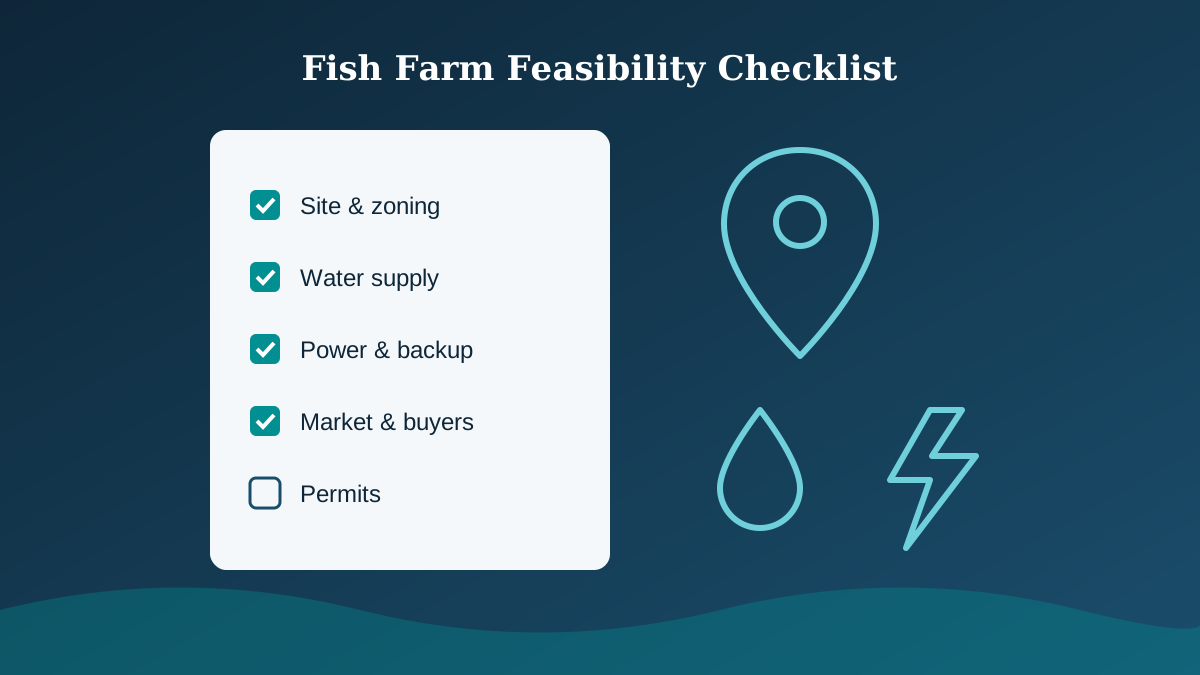
A fish farm feasibility review tests whether your project can work at your site, with your species and system, for your market and budget, before significant money is spent. The ten key questions cover the market, species, system, water, power, site and zoning, permits, capital cost, operating cost, and team. If any answer is "we don't know yet," that's where to focus next.
Why feasibility comes first
Most of the costs that decide a fish farm's future are locked in before construction starts. A feasibility review is the cheapest point at which to change course, or to confirm you're on the right one. It's the practical side of bringing in expert input early.
The 10 questions
1. Who will buy the fish, and at what price?
Start with the market, not the tanks. Identify real buyers, the product form they want (whole, fresh, frozen, live), volumes, and a realistic price. Sales channel development is part of feasibility, not an afterthought.
2. Is the species a good fit?
Consider growth rate, market demand, availability of juveniles or seed stock, feed, disease risks, and whether the species is permitted at your location.
3. Which production system makes sense?
Land-based recirculating aquaculture systems (RAS), flow-through systems, ponds, and sea cages have very different capital costs, operating costs, and risks. Compare them honestly for your species and site.
4. Is there enough water of the right quality?
Every system needs a dependable water source. Check quantity, quality, salinity, temperature, and year-round reliability, plus how wastewater will be handled.
5. Is there reliable power, and a backup?
Land-based fish farming depends on electricity for pumps, oxygen, and temperature control. Confirm capacity, cost, and grid reliability, and plan for backup power from day one.
6. Does the site work: zoning, access, and space?
Confirm zoning allows aquaculture, trucks can reach the site, and there is room to expand. Proximity to buyers and suppliers matters too. See our site selection service.
7. What permits are required, and how long will they take?
Permitting can shape your schedule more than construction does. Map every approval early; our aquaculture permitting guide explains how.
8. What will it cost to build, and how will it be funded?
Estimate construction, equipment, contingency, and start-up costs, and identify where the capital will come from. An investor-ready business plan builds on these numbers.
9. What will it cost to operate, and when do you break even?
Model feed, energy, labor, juveniles, maintenance, and overhead against a realistic bio plan. Include the time before first harvest, when costs run with no revenue.
10. Who will build and run it?
Identify the people with the skills to manage construction, husbandry, water quality, and sales, and where outside expertise, SOPs, and training will fill gaps.
What should you do with the answers?
If the answers hold up, they become the foundation of your business plan and financial pro forma. If they don't, you've learned it at the lowest possible cost. Either way, it's worth having someone who has built and operated a land-based farm pressure-test the assumptions.
Get a feasibility review
Aquaco Advisors LLC helps clients from small farms to government agencies and international projects evaluate feasibility. Our founder took a commercial land-based marine RAS facility in Florida from business plan to successful exit, so we know which questions matter most. Learn how a full aquaculture feasibility study works, or schedule a consultation.
Frequently asked questions
What is a fish farm feasibility study?
A fish farm feasibility study tests whether a project can work at a specific site, with a specific species and production system, for a specific market and budget, before major money is committed.
What questions should a fish farm feasibility review answer?
Who will buy the product and at what price; whether the species fits; which system makes sense; whether water and power are adequate; whether the site's zoning, access, and space work; which permits are needed; capital and operating costs; and who will build and run the farm.
Is land-based fish farming profitable?
It can be, but profitability depends on the species, system, site, energy and feed costs, market price, and management. That is exactly what a feasibility review is designed to test.
When should I do a feasibility review?
Before you buy land, order equipment, or commission a detailed design, when changing course is still inexpensive.