What Does an Aquaculture Consultant Do? A Phase-by-Phase Guide
Quick answer
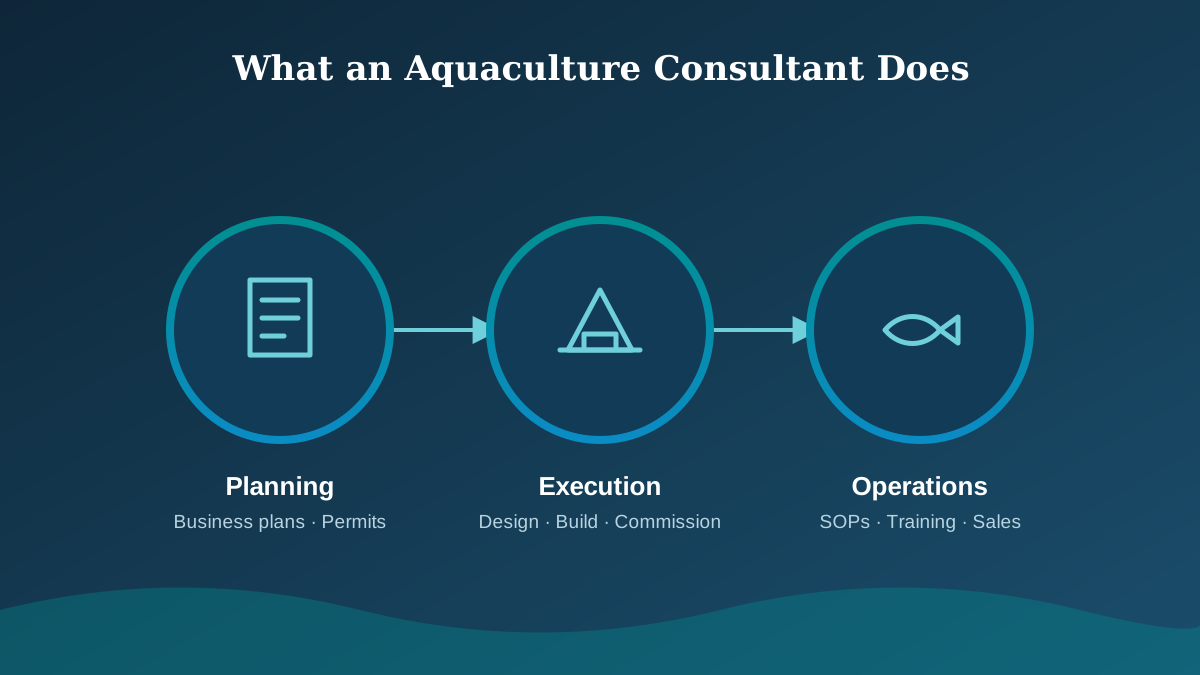
An aquaculture consultant is an independent expert who helps fish and seafood farming projects make better decisions at every stage: planning (business plans, feasibility, site selection, permits), execution (system design, construction budgeting, equipment, commissioning), and operations (standard operating procedures, staff training, sales). You can hire one for an entire project or for a single task.
What is an aquaculture consultant?
An aquaculture consultant brings outside expertise to a fish, shellfish, or seafood farming project. Clients range from first-time investors and small farms to government agencies, public zoos and aquariums, and large international programs. What they have in common is a decision that is expensive to get wrong, and a wish to make it with the benefit of someone who has faced it before.
The best consultants have done more than study aquaculture. They have planned, financed, built, and run facilities themselves, so their advice reflects what actually happens once water is in the tanks. That operating experience is what separates practical guidance from theory.
What does a consultant do in the planning phase?
Planning is where a consultant typically adds the most value for the least cost, because the biggest cost drivers are decided early. Typical planning work includes:
- Aquaculture business plans that explain the market, production approach, and path to profitability (see our business plan guide).
- Financial pro formas and bio plans that tie production assumptions to the numbers.
- Capital raise support, including answering investors' technical due-diligence questions.
- Site selection and fish farm feasibility reviews.
- Regulatory approvals and government permits, covered in our permitting guide.
What does a consultant do in the execution phase?
Once a project is funded and approved, the job shifts to turning plans into a working facility on budget and on schedule:
- System design and engineering for recirculating aquaculture systems (RAS), life support systems (LSS), hatcheries, and grow-out facilities. Our RAS design guide explains the main components.
- Construction budgeting and timeline management to catch cost and schedule risks early.
- Equipment procurement and selection, choosing pumps, filtration, oxygenation, and monitoring that fit the system rather than the sales pitch.
- Installation and commissioning, confirming every system performs as designed before animals go in.
What does a consultant do in the operations phase?
A running farm has different problems: consistency, labor, costs, and sales. Operations support usually covers:
- SOP development and staff training so daily husbandry, water quality checks, maintenance, and emergency response are done the same way every time.
- Sales channel development and pricing negotiation to get product to the right buyers at the right price.
Should you hire for the whole project or one task?
Both work. End-to-end support suits owners who want a partner from the first plan through stable production. Single-task engagements suit teams who are capable but want an experienced second opinion on one decision, such as whether a site is workable, whether an equipment list is right-sized, or whether a pro forma will survive investor review.
A good consultant will tell you honestly which one you need. Often the right first step is a focused review that confirms you're on track or flags an issue while it's still cheap to fix.
How do you choose an aquaculture consultant?
Ask these questions before you hire anyone, including us:
- Have they built and operated a facility themselves? Hands-on operating experience changes the quality of advice.
- Which systems and species have they worked with? RAS, sea cages, hatcheries, and life support systems each have their own challenges.
- Are they unbiased? Ask whether they are paid by equipment vendors, and whether their recommendations are shaped by what they sell.
- Do they have a network? Strong relationships with vendors, suppliers, and specialists give you access to more expertise than one person can offer.
- Will they scope the work to what you actually need? Be wary of anyone who proposes a large engagement before understanding your project.
What should you bring to a first consultation?
You don't need everything figured out. It helps to share your goals, the species and system you're considering, any site information, a rough budget range, your timeline, and the decisions keeping you up at night. From there, a consultant can tell you where outside input would help most. Schedule a consultation by phone, Microsoft Teams, or Zoom.
Frequently asked questions
What does an aquaculture consultant do?
An aquaculture consultant helps fish and seafood farming projects through planning (business plans, feasibility, site selection, permits), execution (system design, construction budgeting, equipment selection, commissioning), and operations (SOPs, staff training, sales channels, and pricing).
How much does an aquaculture consultant cost?
It depends on the scope. A focused review of one decision costs far less than end-to-end project support. Ask for a proposal scoped to the specific help you need.
Can I hire an aquaculture consultant for just one task?
Yes. Many engagements are a single task, such as a site review, a business plan, equipment selection, or staff training. Aquaco Advisors LLC offers every service on its own.
Is RAS consulting different from general aquaculture consulting?
RAS consulting focuses on recirculating aquaculture systems: land-based systems that filter and reuse water. It requires specific knowledge of filtration, biofiltration, oxygenation, and redundancy, on top of general aquaculture business and husbandry experience.